 |
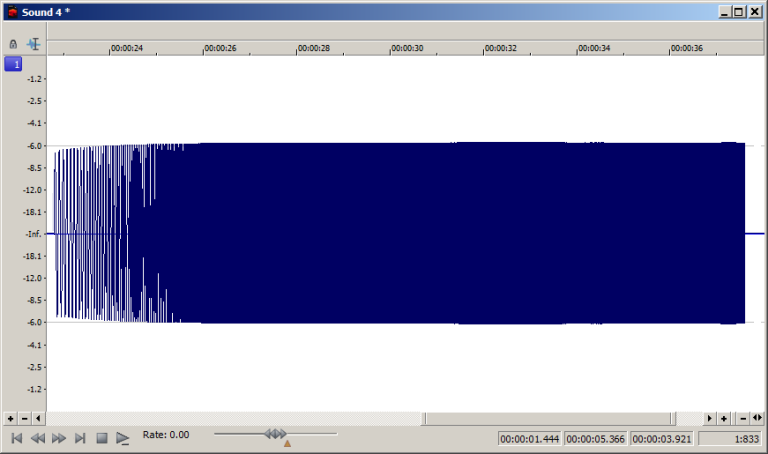
| Figure 1: This screen shows the level of frequencies from 10 Hz through 20 kHz as played from a ClipJam media player and recorded into Sound Forge. |
| www.ethanwiner.com - since 1997 |
How Much Should a Good DAC Cost?
by Ethan Winer
I'm active in many online forums and Facebook groups. Not just groups for audiophiles and home theater fans, but also places where amateur and professional recording engineers hang out. My professional background includes recording, electronic circuit design, acoustics, and music. So I have a pretty good handle on how audio works. This article presents technical data, but nothing too complicated for even beginners to follow.
One of the most frequent questions I see asks about the quality of DACs: the Digital to Analog Converters used in all modern audio devices such as CD and Blu-ray players, as well as music streamers and smart TVs. Many people, unhappy with the sound of their systems assume - wrongly - that their DAC is the limiting factor and should be improved with a better model. But DAC design is an established science. All modern competent DACs are sufficiently clean to not alter the sound enough for human ears to notice. This means that the frequency response is flat with 1 dB or so over the audio range of 10 Hz to 20 kHz, with distortion and noise too soft to hear. Test gear can easily measure distortion as small as 0.001 percent or even less, which equates to a level 100 dB below the music. But our ears can barely hear distortion or other artifacts 80 dB below the music under the most favorable conditions. Even 1 percent distortion only 40 dB below the music can be difficult to identify reliably in many cases.
AudibleTransparency
When an audio device has a frequency response that's acceptably flat, with noise and distortion too soft to hear, that device is considered to be audibly transparent. Audio circuits and their components have improved enormously over the past 20-30 years, and many modern devices are good enough to make that claim. In 2018 I bought a SanDisk ClipJam media player to listen to through my kitchen boom box while making dinner. It cost all of $30 and sounded great. Just for fun I measured the frequency response and distortion using Sound Forge audio editing software. For the response test I played a 24-bit Wave file containing a sweep from 10 Hz to 20 kHz from the player into Sound Forge. Seeing the level of the waveform versus frequency reveals the response. For the distortion test I played a Wave file at 400 Hz, then examined the added distortion components (harmonics) with an FFT display. FFT stands for Fast Fourier Transform, and is a standard feature with most audio editing programs.
I created the files in software at 24 bits because that gives even less distortion than standard 16-bit CD quality. Then I copied those files into the ClipJam via its USB port. Of course, the distortion of the Focusrite Scarlett 8i6 sound card I used to record these files also adds to any response errors and distortion. But my Scarlett is very good, and the ClipJam could only be better than these figures show for both devices, not worse. Figure 1 shows the response sweep, and you can see that even at 10 Hz the response is down less than 1 dB, then stays flat through to 20 kHz
|
| Figure 1: This screen shows the level of frequencies from 10 Hz through 20 kHz as played from a ClipJam media player and recorded into Sound Forge. |
For the distortion test I used Sound Forge's FFT display shown in Figure 2. As you can see, the 400 Hz tone is at a level of -6 dB and the second harmonic at 800 Hz is at -96 dB. That 90 dB difference equates to a distortion amount of 0.0032 percent. Pretty good for a $30 player the size of a matchbook! The remaining harmonics are even softer, as is the Scarlett's claimed distortion of 0.001 percent. So after combining all of the added distortion frequencies the ClipJam's own distortion is likely less than 0.01 percent. That's right at the -80 dB threshold where noise and distortion simply can't be heard. And a lot better than any loudspeaker or tube amplifier. Our own ears add more distortion than that!
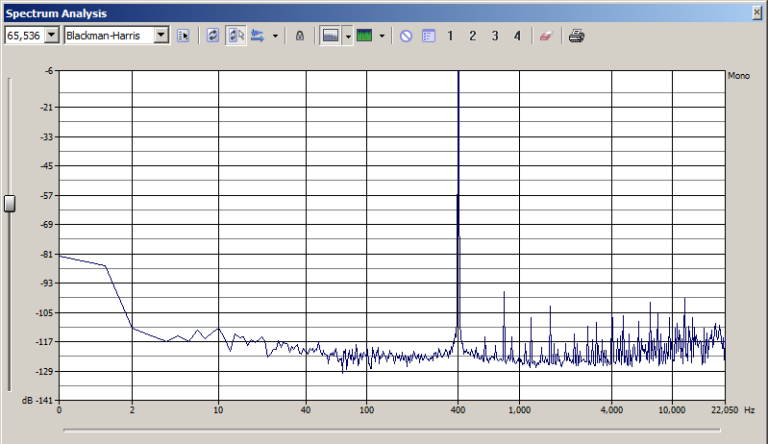 |
| Figure 2: This FFT display shows the 400 Hz tone recorded from a ClipJam media player, plus all of the distortion frequencies added by the player and their amounts. |
Diminishing Returns
These days even budget DACs will be at least as clean as my $30 media player, with amplifiers and especially loudspeakers being worse. So once a device is known to be audibly transparent, anything "better" probably won't make a difference. The correct way to determine the quality of an audio device is with its published specs. I assure you there are no aspects of audio fidelity that are "unknown" by audio engineers, no matter what you might read in hi-fi magazines. The only real problem is getting all of the specs that matter.
By definition, "fidelity" means how faithful a copy is to its source. Only four parameters are needed to define everything that affects the fidelity of audio equipment: Frequency response, distortion, noise, and time-based errors. All of these parameters have subsets, such as hum and vinyl pops under Noise, and resonance under Frequency Response. But be assured that these basic parameters define everything that affects audio fidelity. The problem is that specs can be incomplete, misleading, or even fraudulent. This doesn't mean they aren't useful - we just need all of the data. However, getting complete specs from audio manufacturers is another matter. Often you'll see frequency response given but without a plus and minus dB range. Or a power amp spec will state harmonic distortion at 1 kHz, but not at higher or lower frequencies where the distortion might be much worse. Or an amplifier's maximum output power is given, but its distortion was spec'd at a much lower level such as 1 watt.
My Damn Lies YouTube video is based on a workshop I gave for the AES (Audio Engineering Society), and it explains audio specs in great detail. Thankfully DACs are simpler than most devices in an audio system. A DAC doesn't have to drive a 4 ohm loudspeaker to 100 watts or more, nor does it have to output 25 Hz at 100 dB SPL as does a subwoofer. All a DAC has to do is convert a series of numbers into equivalent analog voltages. As I said earlier this is established science. Internally most DACs use converter ICs made by just a few major semiconductor companies. From ChatGPT:
It's worth noting that today's flagship DAC chips from ESS, AKM, TI, Cirrus Logic, and ROHM all achieve performance that exceeds the limits of human hearing under normal listening conditions. Typical specifications include:
Dynamic range: 120-140 dB THD+N: better than -110 dB, with the best around -125 dB Flat frequency response across the audio band Very low jitter sensitivity when implemented properly.
So finally we can answer the question, "How much should a good DAC cost?" If you Google "Best affordable DACs" you'll get a number of products costing $100 or less. But much more relevant is asking "Do I even need to buy a DAC?" Since the DAC in your receiver or CD player is almost certain to be audibly transparent, there's little point in replacing it with another DAC, even if the replacement has better specs. Again, the audibility threshold for distortion is around -80 dB in the most favorable conditions. And no modern DAC or other audio device I know of is nearly that bad. If you're just dying to spend money to improve your system, I suggest looking into acoustic treatment. The response of any decent DAC varies by a fraction of a dB. But even if your loudspeakers are very flat, once they're in your room their response varies by 30 dB or even more. Yes, really. Especially in the bass range. Figure 3 shows the low frequency response measured in a typical untreated listening room. Yikes!
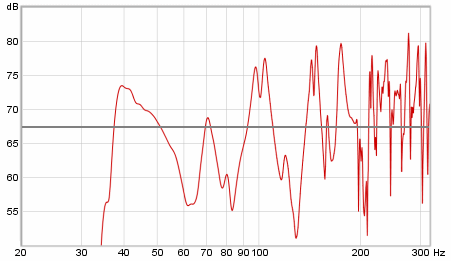 |
| Figure 3: This graph shows the low frequency response measured in a typical living room with no bass traps or other acoustic treatment. |
Finally, I live to bust myths, so I'll add a bit about jitter which is often claimed to matter greatly in DACs. In truth, jitter never matters because even when ten times worse than typical it won't be audible. I'll skip the technical details here, but I tested this for a 2024 article in audioXpress magazine that explains jitter in detail. The article also includes a video I made that lets you hear jitter in amounts ranging from typical to 10,000 times more! Only when jitter is much greater than normal can its artifacts be clearly heard.
Ethan Winer has been an audio engineer and professional musician for nearly 60 years, and is a principle at RealTraps where he designs acoustic treatment products for recording studios, home theaters, and listening rooms. Ethan's Cello Rondo music video has received nearly 2 Million views on YouTube and other web sites. His two books, The Audio Expert and The Audio Circuits Cookbook, both published by Focal Press, are available at amazon.com and his own web site.
Entire contents of this web site Copyright © 1997- by Ethan Winer. All rights reserved.